Juno's Undergraduate Student Loan Guide
Here's what you need to know about the process, updated for the 2026-27 school year.
Parent PLUS loans are now capped at $20,000 per student per year ($65,000 lifetime) for families borrowing for a student who first took out an undergraduate loan after July 2026. For a lot of families, that means private loans now cover a bigger share of the bill.
Top 8 Most Popular Questions
1. When do I start?
Usually a month before the tuition billing due date. If the student is starting in the fall, July is a common month to apply. You can apply as soon as your school is able to certify the loan amount though.
2. How long does it take?
Usually a few weeks from start to finish. You can usually get initial quotes pretty quickly (within a few days) and decide what to do from there.
3. Where does the money go?
The lender sends the loan to the school. If you are taking out funds to cover living expenses (like an apartment), the school will send anything beyond their costs to the student.
4. What do most families do in terms of loans?
They hit the Federal Direct cap first. Depends on the student but starts at $5,500. Then if they need more they decide between federal Parent PLUS and private student loans. That decision changed for 2026-27: Parent PLUS is now capped at $20,000 per student per year, with a $65,000 lifetime limit per student, for families borrowing for a student who first took out an undergraduate loan after July 2026. For those with good credit scores (650+), private loans tend to be cheaper anyway.
5. What kind of private loan do they take out?
The most common are fixed interest 10 year loans. Many don't want to pay anything while in school (deferred) but the smarter strategy is often to pay a little while in school to get a lower interest rate. If you pay $25 every month for example it can result in significant savings, especially when you use the autopay discount.
6. Can I pay off the loan early?
Yes. There are no penalties or fees associated with this.
7. Does it matter if my student doesn't have a credit score?
Usually the student's credit score doesn't matter if the parent is cosigning (the most common situation).
8. How much can I take out?
On a private loan, up to the school's stated cost of attendance minus any financial aid received. Federal Direct loans vary by year and dependency status, starting at $5,500. Parent PLUS is capped at $20,000 per student per year and $65,000 over the student's lifetime if the student first borrowed for undergrad after July 2026; families who borrowed before then are grandfathered into the old cost-of-attendance limit for up to three years, or until the program's anticipated end -- whichever comes first.
What Changed for 2026-27
Federal student loan rules changed for anyone taking out a new federal loan on or after July 1, 2026. Two changes matter most for undergraduate families:
Parent PLUS loans are now capped
Parent PLUS borrowing used to run all the way up to the cost of attendance minus other aid. For families borrowing for a student who first took out an undergraduate loan after July 2026, it is capped at $20,000 per student per year, with a $65,000 lifetime limit per student. Families who already borrowed for the student's current program are grandfathered into the old limits for up to three years, or until the program's anticipated end -- whichever comes first.
Parent PLUS is more expensive than it looks
Parent PLUS carries a high 9.07% interest rate plus a 4.228% origination fee, and incoming Parent PLUS borrowers are no longer eligible for income-driven repayment plans. Parents with credit scores above 650 may find better rates through private loans, though some federal repayment protections would not apply.
Federal loan limits and rates for undergraduates in 2026-27
| Federal Direct Loans | Parent PLUS Loans | |
|---|---|---|
| Maximum loan amount (first borrowed for undergrad before July 2026) |
Varies by year and dependency status, $5,500 and up | Up to the cost of attendance minus other aid received |
| Maximum loan amount (first borrowed for undergrad after July 2026) |
Varies by year and dependency status, $5,500 and up | $20,000 annual limit / $65,000 lifetime limit, per student |
| Interest rate | 6.52% | 9.07% |
| Origination fee | 1.057% | 4.228% |
An origination fee is an extra service charge for taking out the loan, so you have to borrow more than you actually need. You have to borrow $10,105.70 to receive $10,000 for school through a Direct Unsubsidized loan, and $10,422.80 to receive $10,000 through a Direct PLUS loan.
Federal rates are set once a year based on the May Treasury auctions, take effect on July 1, and stay fixed for the life of the loan. To apply for federal student loans, students must complete the Free Application for Federal Student Aid (FAFSA). Federal loans come with a standard repayment schedule plus a wide range of repayment assistance options.
Want the full breakdown of the federal changes, including the new repayment plans? Read our federal student loan updates guide.
How Most Families Stack Their Loans
When loans are needed, students should first maximize federal direct loan (subsidized and unsubsidized) borrowing, because of the lower interest rates and federal repayment protections. Remaining gaps beyond that limit can be filled with Parent PLUS or private loans -- and with Parent PLUS now capped at $20,000 a year, private loans cover a bigger share of the bill than they used to.
Federal vs. Private: Feature Comparison
Federal student loans have less stringent approval requirements. Private student loans include a credit review to determine the borrower's anticipated ability to pay, which is what sets the interest rate. Federal loans also come with benefits unique to the federal program, such as Income-Driven Repayment plans and Public Service Loan Forgiveness.
Federal Student Loans
Private Student Loans
Interest rates & in-school features
Federal
- Fixed rates
- No credit check on Direct loans
Private
- Rates are based on credit
- Choice of variable or fixed rates
- Hard credit check required
- A cosigner may be needed for approval or the best rates if the student has not built a strong credit profile
- For Juno members, we expect our lending partners to provide great rates and eligibility for undergraduate students even without a cosigner
Forgiveness & flexibility
Federal
- Eligible for loan forgiveness programs, including Income-Driven Repayment and Public Service Loan Forgiveness
- Deferment and forbearance available
Private
- No formal forgiveness programs
- Check the fine print for a death or disability forgiveness clause
- Deferment options can vary by lender and loan product
Repayment Options
Loan term (also called the repayment term)
The loan term is how long you will take to repay the loan. Paying the loan back sooner results in a lower overall total cost, but larger monthly payments. A longer term lowers the monthly payment but costs more overall. Terms vary by lender, and some lenders assign you a term without giving you the choice. Juno's partners often let you choose from 5, 7, 10, 12, 15, or 20 years.
In-school repayment
The two biggest decisions are whether you want to make payments while the student is in school or defer until they graduate, and how much you want those in-school payments to be. Making in-school payments reduces the overall cost of the loan because you start paying down interest sooner.
Juno's partners let you choose from a wide variety of repayment options:
- Fully deferred -- no payments in school
- Fixed minimum / flat -- $25 monthly payments in school
- Interest only -- interest payments in school*
- Full repayment in school -- principal and interest payments in school*
*Interest Only and Full Repayment In School options require a cosigner or qualifying income.
What would we do?
We expect most students to choose a fixed interest rate with a deferred or fixed minimum / flat repayment plan. A deferred plan puts payments on hold while in school, but interest keeps accruing, which makes the option more expensive over time. The interest-only and fixed minimum / flat plans start payments while in school, so you pay a bit less interest over time and can often take advantage of the autopay discount immediately.
When choosing a loan option, think about what the monthly payment will look like after graduation and pick a term that fits that expected budget.
A bit more about interest
Interest accrues on the loan as soon as it is disbursed to the school, and it accrues daily. Any payment -- scheduled or extra -- first pays off accrued interest; anything beyond that goes to principal.
Your minimum payment on an interest-only plan is designed to cover about 30 days of interest, so an extra payment scheduled on the due date would typically go 100% toward principal. Paying the loan off early reduces the total interest paid over the lifetime of the loan, and there is no prepayment penalty.
Getting the Lowest Rate
Do not assume that all lenders are the same -- pricing varies significantly from one lender to another. At Juno, we bring multiple lenders to the table and have them compete against each other, which is how we negotiate lower rates for our members. We also screen our partner lenders to make sure they charge no application fees and no origination fees. Some lenders do not make those fees obvious, so call and ask specifically whether they charge either one.
Auto pay discounts
Many, but not all, lenders reduce your interest rate for making automatic payments. Keep in mind the discount usually only applies when you have payments due, so on a deferred plan it starts after graduation, once repayment begins. Juno partners often offer this.
Special discounts
Some lenders offer unique ways to lower your rate even further. A relationship discount, for example, can reduce your interest rate for using additional products or services from the same lender.
Cosigners
A cosigner is obligated to pay back the loan just as the borrower is. On undergraduate loans the student typically takes out the loan and the parent cosigns -- loans in the parent's name alone can be more expensive. Since the parent is cosigning, it is fine if the student does not have a credit score yet; lenders primarily evaluate the parent's creditworthiness. Once the student graduates, it is common to refinance everything into one loan in the student's name.
Variable vs. fixed interest rates
A fixed rate stays the same for the life of the loan. A variable rate can move up or down over your repayment period as the index the lender selected changes -- for student loans that is usually the Secured Overnight Financing Rate (SOFR). A variable rate may be cheaper on the day you apply, so consider your tolerance for the risk that it moves over the years.
Juno's partners let you choose from competitive variable and fixed rate options. Most members prefer fixed rate loans at this point in time.
The Private Student Loan Process
It is generally best practice to start the application process at least 30 days before your school's tuition due date, though you can apply earlier -- and some students get through the entire process within a week. If the student is starting in the fall, beginning in June or July is fairly standard. Interest does not accrue until the funds are disbursed, generally a couple of weeks before classes start, so there is no downside to getting started early.
1. Apply
You will enter your personal information, school information, and requested loan amount. If you are applying with a cosigner, you will either enter their information at the same time as yours or ask the lender to contact them directly. We recommend checking your rate through Juno during this process -- we negotiate rates that can be lower than going directly to a lender, and may have a rate match guarantee program with bonus cash back.
2. Approve
The lender runs a hard credit check and comes back with one of three results: approved, denied, or eligible with a creditworthy cosigner. Some lenders are instant; others require a manual review that takes a few days, or request documents like paystubs or 1099s.
3. Accept
If you are approved, you choose your terms and accept the loan: variable or fixed interest rate, loan term, and repayment plan. Then you sign the remaining documents to confirm the terms and conditions.
4. Wait
The rest of the process generally happens between the lender and the school. The school approves the student's enrollment status, anticipated graduation date, and loan amount versus cost of attendance, then certifies the loan as-is or requests changes. This takes anywhere from 1 day to 2 weeks, and can take longer if you apply before tuition bills come out. Check the student portal and email for action items -- some schools need you to confirm before they can certify. Calling the financial aid office for guidance helps.
5. Disburse
The lender sends the funds directly to the school, usually once per semester if you applied to cover more than one term. Disbursement dates are set by the school around the beginning of the semester, and interest only starts accruing on funds already disbursed. Any loan amount above the cost of tuition is transferred to the student by the school as a refund, which can be used for rent, textbooks, a computer, and other living expenses.
6. Repay
Payments are made through your lender's portal. Depending on the repayment plan you chose, you may start paying as soon as school starts, or not until after graduation. Most lenders offer an autopay discount, which you qualify for whenever your loans have an active payment status.

What is a Student Loan?
A student loan is when you or your guardian borrows money in order to pay for college. You can take out student loans for a number of reasons, and apply them to many different degree programs.
When a student loan is taken out, it’s usually only for one year of attendance. Most federal loans are disbursed per semester within an academic year. If you're borrowing for the academic year 2026-2027, you would likely get one installment at the beginning of fall semester 2026, and then another installment at the beginning of spring semester 2027.
You don’t need to stick with the same student loan provider for 4 years. You can borrow only federal loans one year, and then borrow from Sallie Mae, for example, the next year.
Federal Loans
For grad students, professional students, and parents of dependent undergrads. These are loans offered by the federal government.
Direct Subsidized Loan
aka Stafford Loans
For eligible undergraduates who demonstrate financial need. Usually the cheapest option available for undergraduate students. The interest you owe doesn’t begin accruing until 6 months after graduation, which is also how long you have before you need to start paying back the loan (known as the grace period).
Direct Unsubsidized Loan
aka Stafford Loans
For eligible undergraduates and graduate students but eligibility is not based on financial need. You also have a 6 month grace period but interest begins accruing immediately after these loans are disbursed.
Direct PLUS Loan
For parents of dependent undergrads (as the Parent PLUS loan). Eligibility is not based on financial need, but a credit check is required. The current rate is 9.07%, plus a 4.228% origination fee. Parent PLUS borrowing is now capped at $20,000 per student per year, with a $65,000 lifetime limit per student, for families borrowing for a student who first took out an undergraduate loan after July 2026. Grad PLUS loans are no longer available to new borrowers after July 1, 2026.
Private Loans
For students and parents alike.
These are loans offered by Juno partners, with no application fees and no origination fees.
Different Loans What They Mean
Stafford Loans
Direct loans to students from the government
Unsubsidized
- 6 month grace period from making payments after graduation
- Begin accruing interest immediately
- No requirement to demonstrate financial need
- Undergraduate AND graduate students are eligible
Subsidized
- 6 month grace period from making payments after graduation
- You only pay interest that begins accruing 6 months after graduation
- Requirement to demonstrate financial need
- Only undergraduate students are eligible
PLUS Loans:
Also via Government
- Taken out by a parent for an undergraduate student
- Interest is higher than Direct loans
- May borrow up to $20,000 per student per year, with a lifetime limit of $65,000 per student, if the student first borrowed for undergrad after July 2026
- No requirement to demonstrate financial need
Private Loans:
Via Juno and Others
- 3rd party loan, not connected to the government
- Interest can be lower than federal student loans
- Income and credit qualifications are often stricter
- Do not include financial hardship guarantees or forgiveness opportunities

Federal Loans
Advantages
Advantages
- Easier to get
- Provides some "insurance" like Income Driven Repayment Programs and Public Service Loan Forgiveness in case you have a low paying job later
- Potentially lower interest rate which often results in lower monthly interest rates and lower total money paid over the life of the loan
- Especially advantageous for those in higher paying jobs that will likely not benefit from federal protections
Disadvantages
Disadvantages
Private Loans
- Potentially higher interest rate
- You may never qualify for federal loan protections and end up paying significantly more money over the life of your loan
- Fewer protections than federal loan, no loan forgiveness
- Not everyone can qualify -- it depends on your credit score and financial situation
What is an Interest Rate?
An interest rate is best understood as the cost of borrowing a certain amount of money. When you take out a student loan or any loan, it will come with this cost. People normally look to get loans that have the lowest interest rates (keeping in mind any associated fees that add to the total cost).
Some loans don’t begin charging interest until a certain time after you graduate, some start charging interest immediately. Interest is expressed as a percentage of the total loan amount. If you took out a $5,000 loan, and your interest was 10% fixed a year, that would mean that every year, $500 would be added to your original loan of $5,000 (assuming you only paid off the interest each year).
While seemingly insignificant, the difference between a 10% and 5% fixed interest rate in the example above could mean more than $250 in savings each year.
Fixed-Rate:
As the example above shows, a fixed rate will stay the same throughout the entire life of your loan
Variable Rate:
A variable rate is when an interest rate fluctuates through the repayment process. These interest rates rise and fall with something called SOFR, which “influential interest rate that banks use to price U.S. dollar-denominated derivatives and loans."
A quick note: Federal loans only offer fixed rates while private lenders usually offer both. Variable rates for private loans are usually lower than fixed rates, but they can go up and down over time.
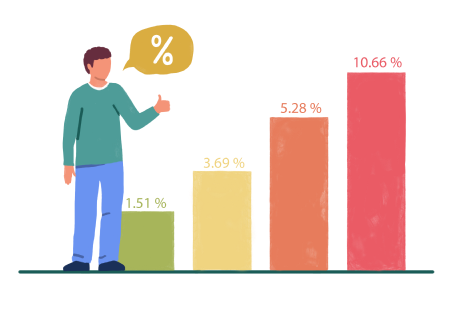
Fees?
Applying for loans can come with fees. Here are a few common ones you may run into.
Origination Fee:
A fee charged by a lender when you first take out a loan. The federal government charges a 1.057% origination fee on Direct Subsidized and Unsubsidized loans and 4.228% on Parent PLUS loans. That means you have to borrow $10,105.70 to receive $10,000 for school through a Direct Unsubsidized loan, or $10,422.80 to receive $10,000 through a Direct PLUS loan. Juno's partners have no origination fee. That might mean the difference between several thousand dollars depending on the amount you borrow.
Prepayment Penalty:
A fee if you pay back your loan ahead of the predetermined schedule. When you graduate, you become a lower credit risk and may be able to refinance your loans at a lower cost. Make sure your loan has no prepayment penalty, so you can refinance with ease. Very few lenders use this. Avoid it whenever possible.
Application Fee:
These are pretty rare. Federal loan applications don’t have application fees, and most private lenders don’t either. If you come across a private lender with an application fee, it’s a red flag, so look closely at your loan terms.

The Basics of Paying for School
Your COA (Cost of Attendance) is estimated by universities using these factors:
Tuition + Mandatory fees for course materials, Room & Board, Health Insurance, Personal Expenses
Schools include multiple estimates for singles, couples, and families. If you aren’t living on campus, already have health insurance, or have scholarships, you may not pay the full COA, as you won’t incur the full cost of the items listed. Keep this in mind when researching schools, and when making other decisions, like if you should move on-campus, get an apartment, or stay at home.
It’s likely you’re going to be applying for financial aid in order to save money on the tuition portion of the COA. There are many different kinds of financial aid, and categories vary between universities. You will typically hear about merit-based aid as soon as you’re admitted. Most schools will have you apply for need-based financial aid after you’ve been admitted and accepted their offer. It’s within merit-based aid that most people are awarded things like scholarships or gift-aid by the school. Need-based aid will be based on separate applications, like FAFSA, or the university’s own need-based financial aid form. It typically takes 3-4 weeks to hear back about need-based aid.
Once you hear back from your university’s aid office, you’ll be presented with an award letter. Think of your financial aid award letter as a first draft as opposed to a finished product. If you really want to go somewhere and the cost after scholarships and aid is too high, try asking for more. Schools won’t rescind your acceptance just because you ask politely for more financial help, so try! Check out our template for negotiating more financial aid here.

A few tips when asking for more aid:
- Be selective about asking. Make sure you really want to go to that program.
- It usually helps if you’ve gotten into more than one school and can credibly tell one school that you’d choose it if you had more aid.
- You’ve already been accepted. They won’t change their minds because you ask for some help politely. So make sure to ask.
Now that that’s out of the way, we can talk about the next step, which is taking out loans to cover what scholarships, merit-aid, and need-based aid won’t cover.
Undergraduates have options when it comes to borrowing student loans. You can take out a federal student loan or a private student loan, you can also choose between taking out a loan in your name or if you have the option, having your parents take a loan for you, through a Parent Plus Loan, or a private student loan with your guardian as a co-signer.
When deciding between federal versus private student loans, there are a few things to consider. Federal Stafford loans will likely have the lowest interest rates but it’s common that students need to borrow more than that federal limit. The federal borrowing limit for dependent undergraduates is usually around $5,500 for the first year.
However, undergraduates who display exceptional financial needs may be eligible for a Pell Grant from the federal government. You should apply to FAFSA, which determines your eligibility for things like additional grants and work-study. Both public and private colleges use FAFSA to gauge your financial situation; applying is a great way to make sure you get access to the aid you are eligible for and don’t end up over-borrowing.
After you’ve applied to FAFSA, figured out your Pell-Grant eligibility, and borrowed to the federal cap, that’s where private loans come in. Private loans are best used for the remainder of financial need and can be used in lieu of a Parent PLUS loan (9.07% with a 4.228% origination fee, and now capped at $20,000 per student per year for new borrowers) which can be more expensive than a private loan. Popular places to borrow private loans include Sallie Mae, College Ave, and Citizens (Juno helps you get discounts from lenders like these).
If you’re a DACA student, financing an education may be tricky, but not impossible. Check out our DACA-specific guide here.
After you’ve borrowed and your loan has been dispersed, we highly recommend remaining organized from the get-go. That means organizing your loans even before you graduate, and knowing when your payback period starts, what kind of loans you’ve taken out, and where they’re held. That way, you won’t be blindsided by payments after your grace period.
Refinancing: The Low Down
What do you do after graduating? Well, you start having to pay back your loans. However, there is a way to save money through this process too, and that's refinancing. Refinancing basically means to finance (something) again, typically by taking out a new loan at a lower interest rate. The new, cheaper loan, pays off the old loan, and you save on the overall loan cost while likely lowering your monthly payment.
When you first take out a loan, the interest rate is set by a variety of factors including your ‘riskiness’ – the likelihood you’ll pay it back. Once you have a steady income, your ‘risk’ is reduced and lenders are more willing to give you a better deal. Refinancing usually works best for graduates who have Unsubsidized Direct Loans, Graduate PLUS loans, and/or private loans. Refinancing federal loans may forfeit certain perks such as public service forgiveness and economic hardship programs.
It’s important to keep in mind what your career plans are and how those may affect your federal loans. If you are going into public service, you may want to keep your federal loans so that you may qualify for Public Service Loan Forgiveness.
We’re here to help!
You can email us at hello@joinjuno.com or call us at (339) 330-4147 with any questions